
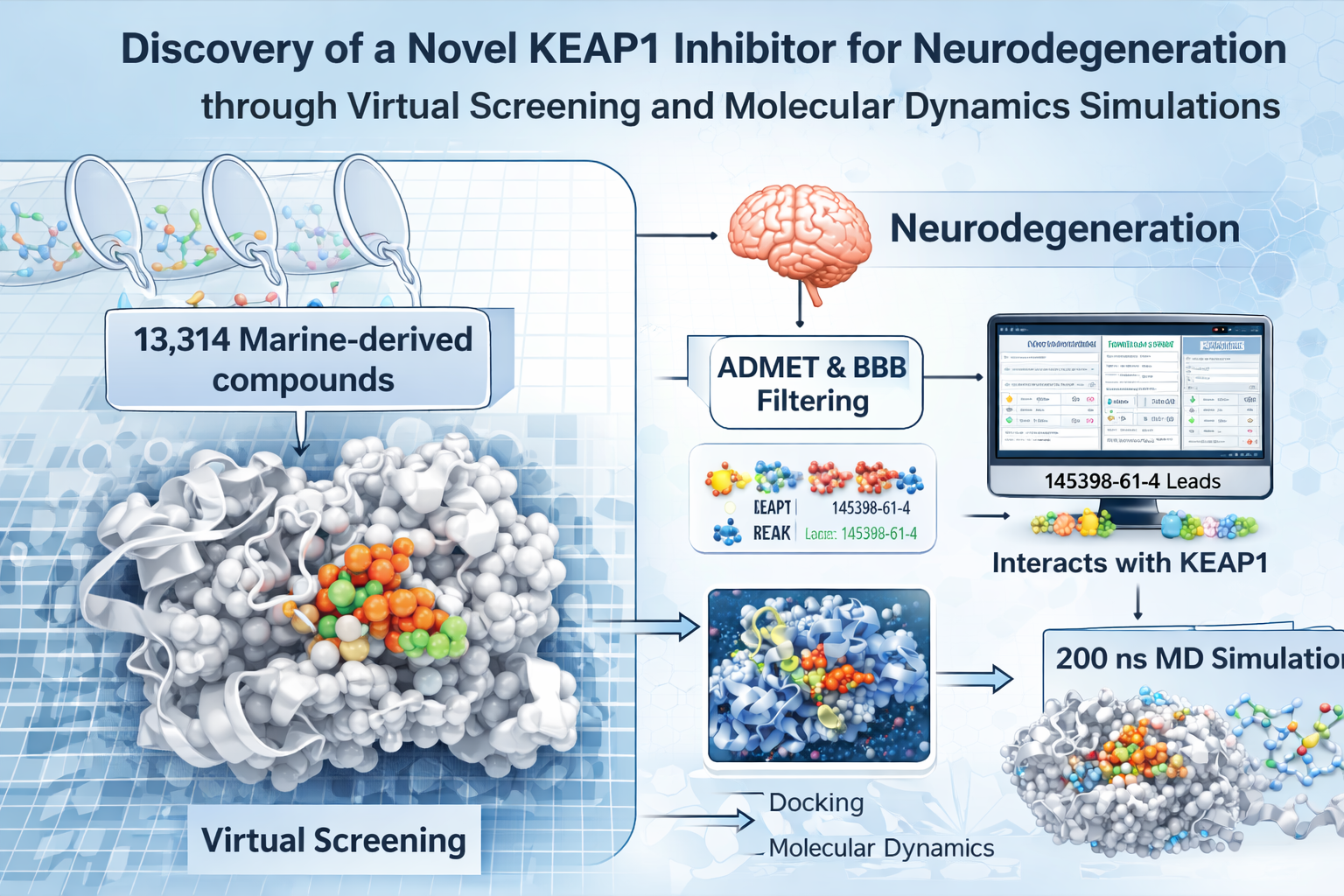
Discovery of a Novel KEAP1 Inhibitor for Neurodegeneration
A study led by Professor Dr. Murad Hossain reports the discovery of a novel KEAP1 inhibitor with potential relevance for neurodegenerative diseases, using an integrated computational approach. The study, published in PLOS ONE (February 2, 2026), targets the KEAP1–Nrf2 pathway, a key regulator of cellular antioxidant defense that is frequently impaired in Alzheimer’s disease and related disorders.
By virtually screening more than 13,000 marine-derived compounds against the KEAP1 Kelch domain, the authors identified several high-affinity candidates. Subsequent ADMET and blood–brain barrier analyses narrowed these to a small set of drug-like molecules. Among them, compound 145398-61-4 emerged as the most promising lead.
Molecular docking and 200 ns molecular dynamics simulations showed that this compound forms stable interactions with critical KEAP1 residues and maintains structural integrity comparable to a reference inhibitor. Binding free-energy calculations further supported favorable complex formation.
While experimental validation is still required, the findings highlight marine natural products as a valuable source of KEAP1 inhibitors and demonstrate the power of virtual screening and molecular dynamics simulations in early-stage neurodegenerative drug discovery.
🔗 Read the full study: https://doi.org/10.1371/journal.pone.0341965