From Lock-and-Key to AI: The Wild Evolution of Molecular Docking
Molecular docking didn’t start as a machine learning tool. Here’s how four decades of incremental fixes got it there.
Every molecular docking run — including the ones behind idgence’s own published screens — rests on an idea that’s older than most of the software used to run it: if you know the 3D shape of a protein’s binding pocket, you can predict how well a small molecule will fit into it. That idea is simple. Getting a computer to do it reliably took about forty years of trial and error.
The lock-and-key era
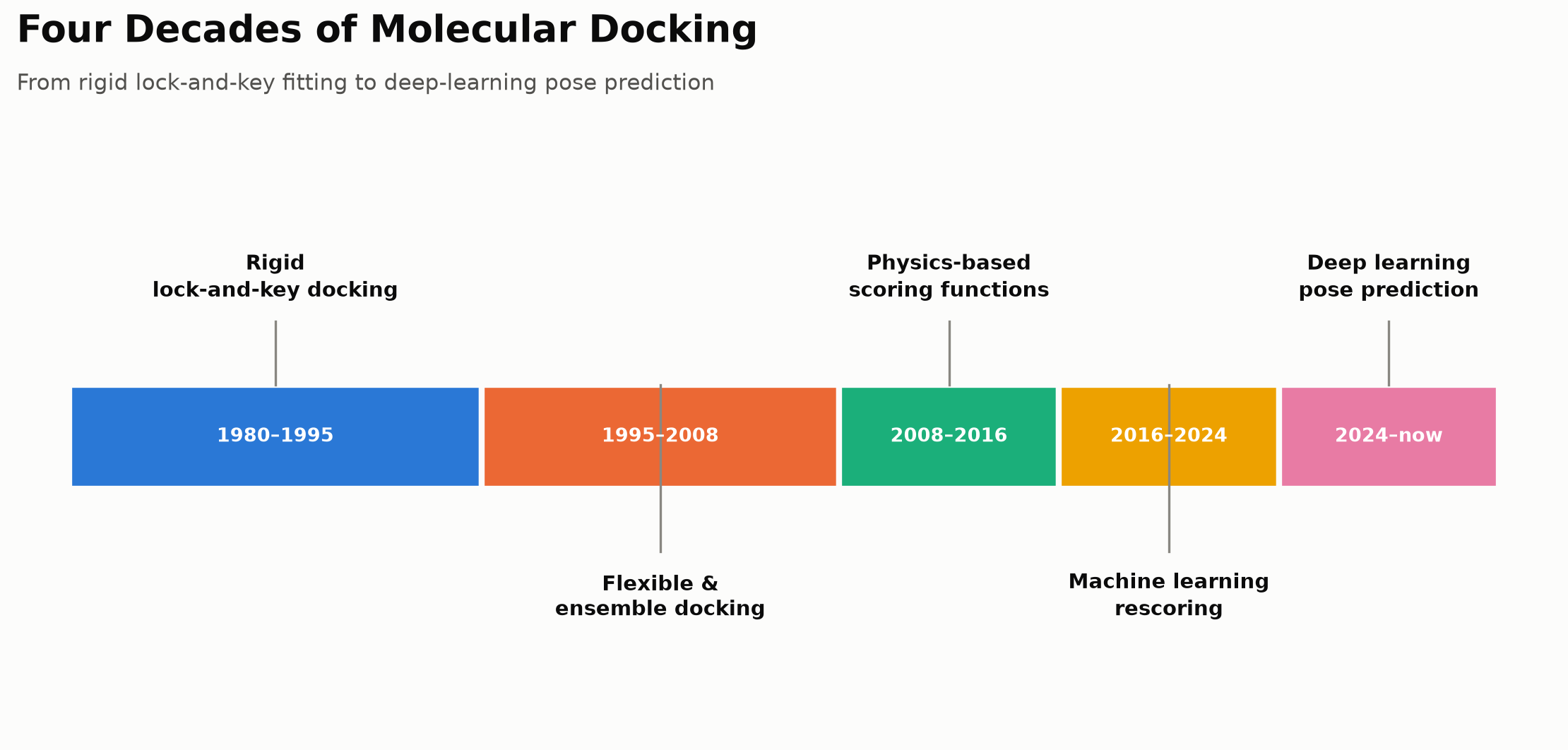
Early docking algorithms, dating to the 1980s and 90s, treated both the protein and the candidate molecule as rigid shapes — essentially solving a 3D jigsaw-puzzle-fitting problem. That assumption was a useful simplification and a real limitation: real proteins flex, and a binding pocket’s shape isn’t fixed. Rigid docking could suggest a plausible fit while missing poses that only become possible once the protein bends slightly to accommodate the ligand.
Letting things move
The next generation of methods, through the 1990s and 2000s, started allowing flexibility — first in the ligand, later in parts of the receptor, and eventually through ensemble docking, which tests a ligand against multiple snapshots of a flexible protein rather than one static structure. This closed a lot of the gap between “fits in theory” and “fits in a real, breathing protein.”
Scoring the fit
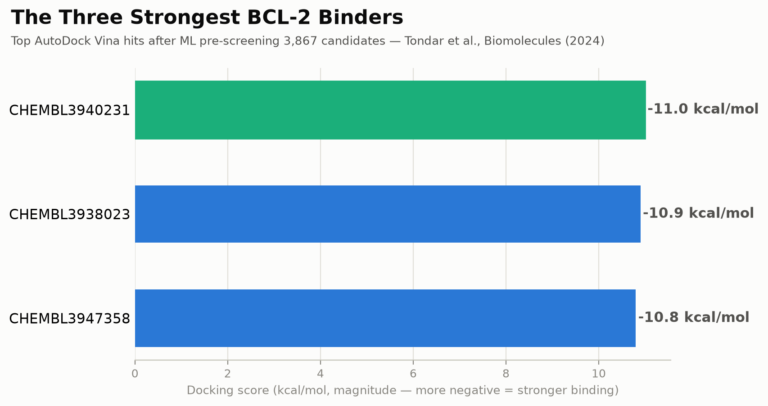
Finding a plausible pose is only half the problem — docking also has to rank poses and candidates by how good the interaction actually is. Through the 2000s and 2010s, scoring functions matured into dedicated physics-based models estimating binding energy from van der Waals forces, electrostatics, hydrogen bonding, and solvation effects. These scoring functions are what produce the familiar kcal/mol numbers you’ll see throughout idgence’s own docking studies — a shorthand for “how favorable does this interaction look.”
Machine learning enters the pocket
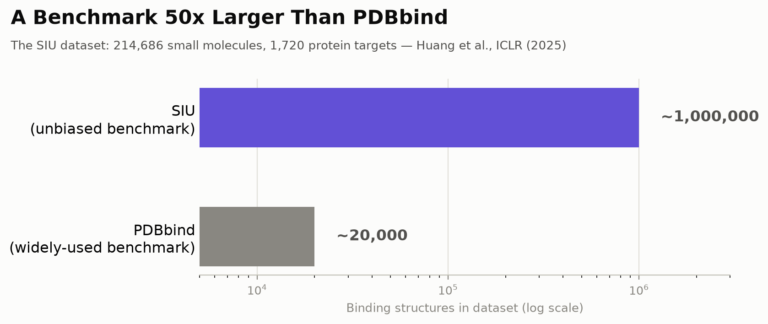
Physics-based scoring functions are principled but imperfect — they’re built on approximations of real molecular forces, and they often struggle to generalize across very different targets. Starting around the mid-2010s, researchers began training machine learning models directly on experimental binding data, letting the model learn scoring patterns rather than deriving them purely from physics. The review this post is based on — a 2026 analysis in Current Topics in Medicinal Chemistry — covers this shift in detail, alongside a comparison of widely used docking platforms like AutoDock, Glide, GOLD, and MOE, and how each has incorporated machine learning and AI into its workflow.
Where it’s headed
The current frontier is deep learning models that predict binding poses directly, rather than searching and scoring thousands of candidate conformations the traditional way. These models are trained on large structural datasets and can be dramatically faster at pose prediction, though — like every earlier advance in this field — they come with their own blind spots and failure modes that the field is still mapping out.
Why the history matters
None of these generations fully replaced the one before it. Modern docking pipelines, including the ones idgence runs, typically still use physics-based scoring as the primary filter, with newer ML approaches layered on top for rescoring or pose refinement rather than as a wholesale replacement. Understanding that lineage makes it easier to read any docking paper’s methods section with the right skepticism: a docking score is never a ground truth, just the current generation’s best estimate — built on forty years of people finding new ways for the previous generation’s estimate to be wrong.
Source: Gogoi PP, Singha B, Longkumer P, Boruah N, Sinha UB (2026), Current Topics in Medicinal Chemistry. doi.org/10.2174/0115680266424314251204071847