Hunting Cancer’s Achilles’ Heel: A Virtual Screen for BCL-2 Killers
How machine learning, docking, and molecular dynamics teamed up to narrow thousands of candidates down to three strong BCL-2 binders.
Cancer cells have a trick most normal cells don’t: they refuse to die on command. A healthy cell that accumulates enough damage is supposed to trigger apoptosis — programmed self-destruction. Many cancers short-circuit that process by overproducing BCL-2, a protein whose job is to block apoptosis. The result is a cell that should be marked for death but isn’t. That makes BCL-2 one of the more direct drug targets in oncology: block it, and cancer cells lose their shield against their own death machinery.
Too many candidates, too little time
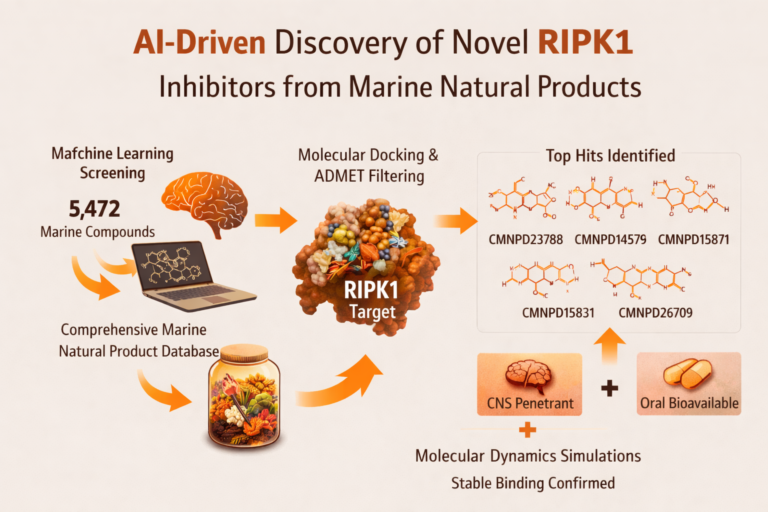
The challenge with a target like BCL-2 isn’t finding a molecule that binds it — it’s finding the few good ones hiding inside a library of thousands. A team including idgence’s Asim Kumar Bepari approached this the way a lot of modern drug discovery now works: let machine learning do the first, fast pass before committing to expensive, detailed simulations.
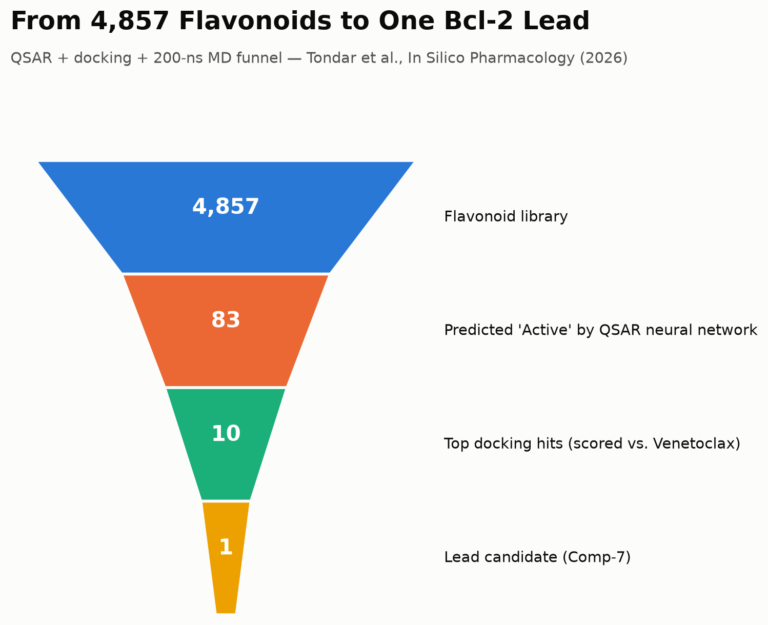
The team trained two kinds of models — a deep neural network and a random forest classifier — on a library of 3,867 small molecules, teaching them to recognize the chemical fingerprint of a likely BCL-2 binder. The random forest model flagged 61% of the library (2,355 compounds) as “Active.” That’s still a lot of candidates, but it’s a start: a crude filter that turns an unmanageable pile into a more tractable one.
Docking narrows it further
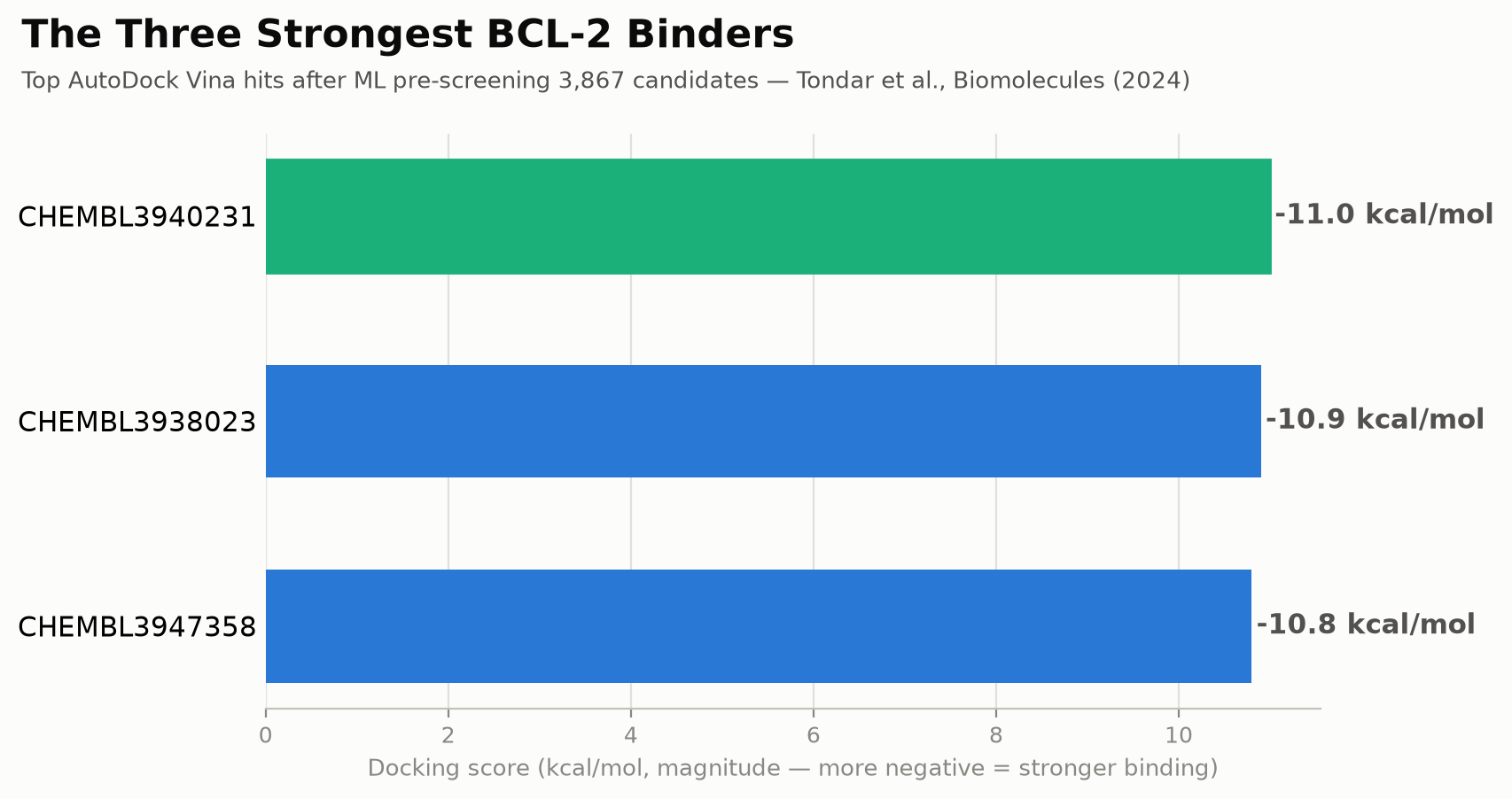
From there, the shortlisted compounds went through AutoDock Vina, which estimates how well each molecule physically fits into BCL-2’s binding site and how strongly it’s likely to hold on. Three compounds stood out: CHEMBL3940231, CHEMBL3938023, and CHEMBL3947358, with docking scores of −11, −10.9, and −10.8 kcal/mol respectively. In docking terms, a more negative score means a more favorable predicted interaction — these three were the strongest binders the screen turned up.
Does the fit actually hold?
A good docking score describes a single snapshot — the best pose the algorithm could find. It doesn’t say whether that pose survives real, dynamic conditions. To check, the team ran molecular dynamics simulations on the top candidates, watching how each BCL-2–ligand complex behaved over time rather than in a single frozen frame. The simulations supported what docking suggested: these compounds didn’t just fit well on paper, they stayed bound and stable when the system was allowed to move.
What this pipeline buys you
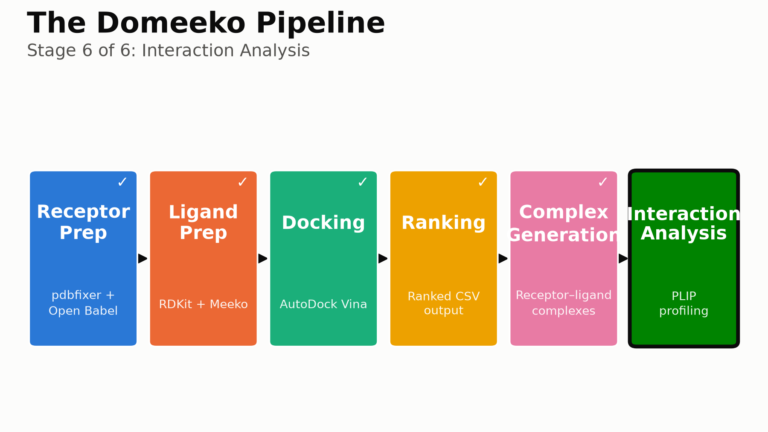
The point of stacking machine learning, docking, and MD simulation isn’t redundancy — each stage does a job the others can’t. ML screening is fast and cheap, good for triaging thousands of candidates but prone to false positives. Docking adds structural reasoning — does this molecule actually fit the pocket — at a cost too high to run on an entire library upfront. MD simulation is the most expensive and most realistic check, reserved for the small shortlist that’s already cleared two filters. Used in sequence, they turn an impossible search (test everything) into a tractable one (test the few candidates everything else agrees on).
None of this replaces a wet lab. CHEMBL3940231, CHEMBL3938023, and CHEMBL3947358 are computational predictions, not confirmed drugs — the next step is experimental validation against real BCL-2 protein and, eventually, cancer cells. But that’s exactly the function this kind of pipeline is meant to serve: turning a search space of thousands into a short, defensible list worth actually testing.
This post summarizes original research co-authored by idgence’s Asim Kumar Bepari. Read the full open-access paper in Biomolecules: doi.org/10.3390/biom14050544