The Flavonoid That Fooled Cancer’s Survival Switch
A neural network, a docking engine, and 200 nanoseconds of molecular dynamics converged on one flavonoid as a serious Bcl-2 inhibitor candidate.
The Bcl-2 protein shows up again and again in blood cancer research because it does one very specific, very dangerous job: it keeps cells alive that are supposed to die. In chronic lymphocytic leukemia, acute myeloid leukemia, and multiple myeloma, Bcl-2 overactivity lets malignant cells dodge apoptosis and resist chemotherapy. There’s already an FDA-approved drug for this — Venetoclax — which makes it a useful yardstick: any new candidate worth pursuing should be able to stand next to it.
Teaching a model to recognize a binder
Rather than starting from docking, this study started by teaching a machine learning model what a Bcl-2 binder looks like. The team computed four different types of molecular fingerprints — Morgan, RDKit, AtomPair, and TopologicalTorsion — for compounds with known Bcl-2 bioassay data, then trained neural network QSAR (quantitative structure-activity relationship) models on each. The Morgan fingerprint model performed best, reaching an R² of 0.804 — a strong fit for this kind of prediction task.
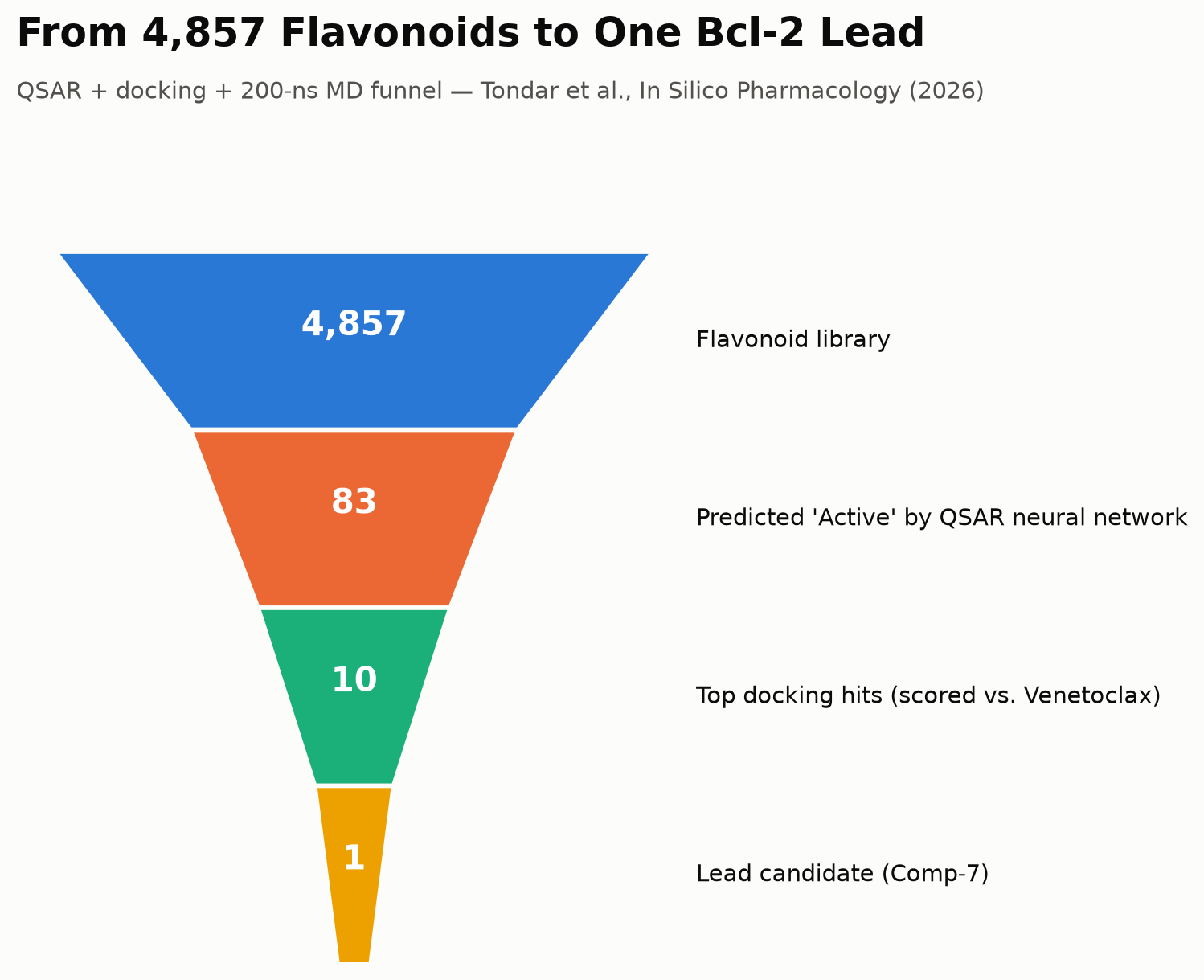
Applied to a library of 4,857 flavonoids, that model flagged 83 compounds as likely “Active.”
From prediction to physical fit
Machine learning predictions are pattern-matches, not proof. To check which of the 83 candidates might actually bind Bcl-2’s pocket, the team ran triplicate molecular docking, comparing scores against Venetoclax as the reference standard. That step produced a top-10 shortlist — compounds whose predicted activity and physical docking fit both checked out.
The 200-nanosecond stress test
The real differentiator came from molecular dynamics. Each of the top 10 candidates was run through replicated 200-nanosecond MD simulations — long enough to separate a lucky docking pose from a genuinely stable one. One compound, labeled Comp-7, stood apart: its root-mean-square deviation (RMSD) converged within the first 20 nanoseconds and stayed below 0.2 nanometers for the rest of the simulation — a sign that the complex found a stable configuration early and didn’t wander from it. Supporting measurements — root-mean-square fluctuation, radius of gyration, and hydrogen bonding patterns — all pointed the same direction: Comp-7 wasn’t just predicted to bind Bcl-2, it stayed bound under simulated physical conditions.
A prenylated flavonoid, specifically
Comp-7’s standout profile is notable because of what kind of molecule it is: a prenylated flavonoid. Prenylation — attaching a small isoprenoid chain to a flavonoid’s core structure — tends to increase lipophilicity, which can strengthen a molecule’s grip on a hydrophobic binding pocket. That’s consistent with what the simulations found: a more stable, longer-lasting interaction than most of the library managed.
Reading the result correctly
Comp-7 is not Venetoclax’s replacement, and this study doesn’t claim it is. What it demonstrates is a disciplined funnel: a neural network trimming 4,857 candidates to 83 on predicted activity alone, docking narrowing that to 10 defensible hits, and 200 nanoseconds of molecular dynamics separating the one candidate that actually holds its pose from the nine that merely looked good in a single snapshot. That’s the methodological throughline across idgence’s computational drug discovery work — stack fast, cheap filters first, and spend the expensive simulation time only on what survives them.
This post summarizes original research co-authored by idgence’s Asim Kumar Bepari. Read the full open-access paper in In Silico Pharmacology: doi.org/10.1007/s40203-026-00662-z