The AI Model That Ignored the Drug — and Still Looked Smart
A 2025 benchmark exposed a shortcut hiding in bioactivity prediction models: one that can score well without ever looking at the molecule being tested.
Most posts on this blog cover a model that worked — a screen that narrowed thousands of candidates down to one worth testing. This one is different, and arguably just as useful: a 2025 ICLR paper that found a serious flaw hiding inside how the field evaluates bioactivity prediction models in the first place.
The question nobody was asking
Bioactivity prediction models are typically benchmarked on their ability to predict how strongly a small molecule binds a protein pocket, given both the pocket’s structure and the molecule’s structure. The implicit assumption is that a good model actually uses both pieces of information — that it’s learning something real about molecular fit. The researchers behind this paper tested that assumption directly, by building a baseline model that only sees the protein pocket and never looks at the small molecule at all.
The result that should worry anyone running these models
On a widely used benchmark — the Atom3D ligand binding affinity dataset — that pocket-only baseline matched or outperformed models that actually use the full protein-ligand complex, across both tested sequence-identity splits (30% and 60%). In plain terms: a model that can’t see the drug candidate at all did about as well as, or better than, models built specifically to evaluate how well that candidate fits. That’s not a subtle edge case — it suggests a meaningful share of what looked like learned chemistry was actually the model exploiting spurious patterns tied to the protein pocket alone, not genuine insight into the molecule being scored.
Why this happens
The authors trace the problem to two compounding issues: the benchmark datasets researchers have been using are too small to force a model to learn real structure-activity relationships, and the standard evaluation approach is conducted at the protein-pocket level rather than the small-molecule level. If a benchmark effectively asks “which pocket is this?” more than it asks “does this specific molecule bind well?”, a model can score well by partially solving the easier, wrong question.
The fix: go bigger, and label differently
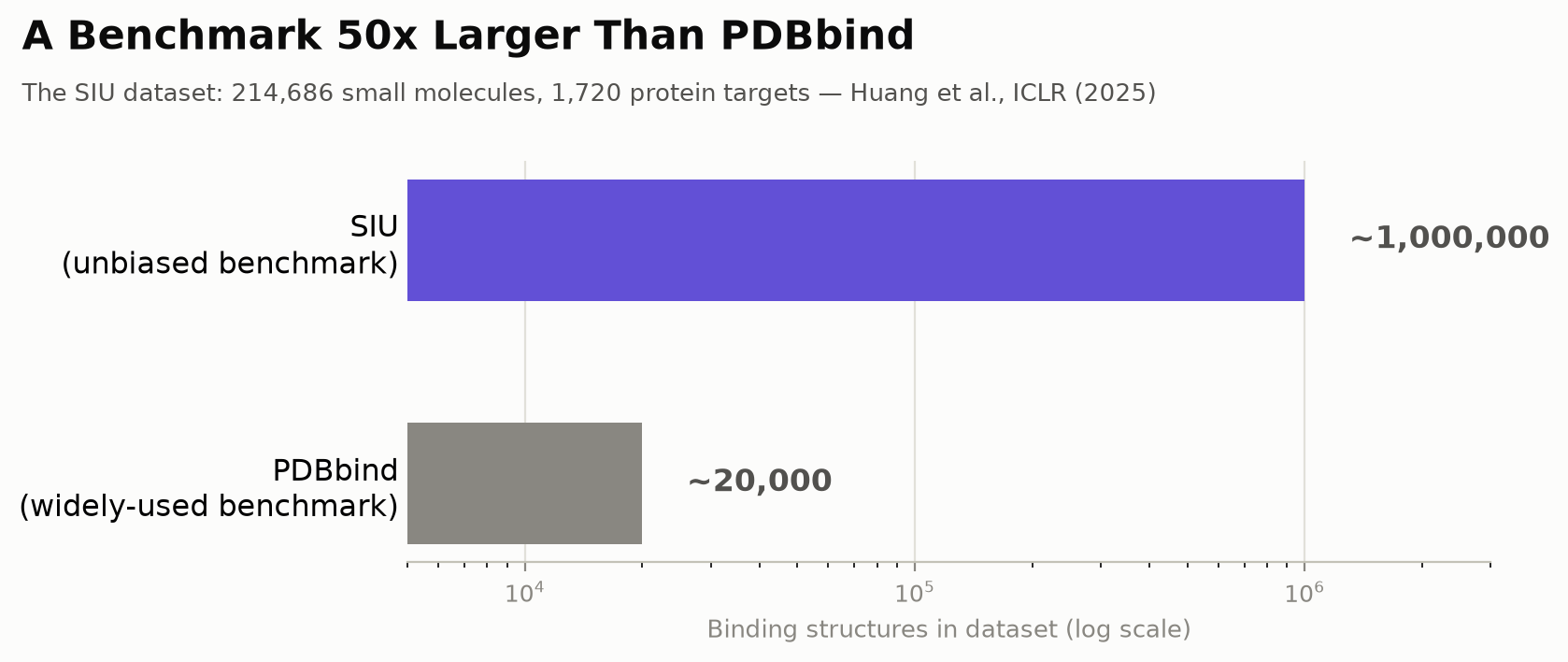
Rather than just pointing out the problem, the team built SIU — a Structural small molecule-protein Interaction dataset for Unbiased bioactivity prediction — containing over a million binding structures, about 50 times larger than PDBbind, one of the field’s most commonly used benchmarks. SIU covers 214,686 distinct small molecules against 1,720 protein targets, with each complex built from a majority-vote consensus across three different docking programs rather than a single method’s output. Critically, because SIU pairs many different molecules against the same protein pockets, it lets researchers evaluate correlation metrics (Pearson, Spearman) across molecules targeting the same pocket — directly testing whether a model can tell a good binder from a bad one for a given target, rather than just recognizing which target it’s looking at.
Why idgence is covering a methods paper, not a drug discovery
This blog generally covers studies that find something — a candidate molecule, a validated structure, a therapeutic lead. This one is different on purpose: understanding where a measurement tool can quietly mislead you is just as important as any individual result built on top of it. Every ML bioactivity model featured on this blog, including idgence’s own QSAR and classifier work, ultimately gets evaluated against benchmarks with the same basic structure this paper interrogates. A result that looks strong on a small, pocket-biased benchmark deserves a healthier dose of skepticism than the same result on something like SIU.
The honest limits here too
SIU’s own complexes come from docking consensus rather than experimentally resolved structures, so its structural quality is itself bounded by how good those docking tools are — a dataset built to fix one source of bias necessarily inherits a different one. That’s not a reason to dismiss it; it’s a reason to read every benchmark, including this one, with the same scrutiny the paper applies to its predecessors.
Source: Huang Y, Gao B, Jia Y, Ma H, Ma WY, Zhang YQ, Lan Y (2025), ICLR. arxiv.org/abs/2406.08961