Nature’s Pharmacy on Trial: Screening Plant Pigments for Brain-Saving Molecules
4,858 flavonoids, one kinase domain, and a 500-nanosecond stability test — here’s how idgence’s team found a leading RIPK1 inhibitor candidate.
Alzheimer’s and Parkinson’s disease share a frustrating statistic: as global prevalence keeps climbing, approvals of genuinely new therapeutics for the central nervous system have not kept pace. Part of the problem is target choice. One protein that’s drawn increasing attention is RIPK1 — receptor-interacting serine/threonine-protein kinase 1 — which plays a central role in neuroinflammation and necroptosis, a form of programmed cell death implicated in neurodegeneration. A potent, well-behaved RIPK1 inhibitor could address a real gap in available treatments.
Why flavonoids
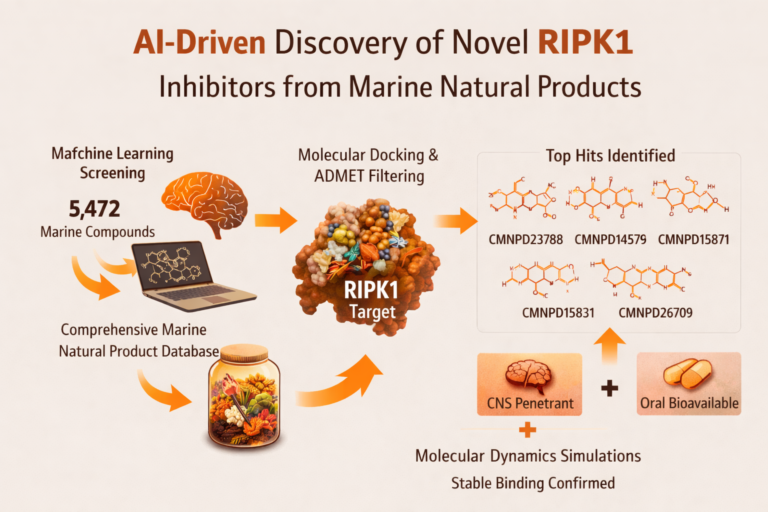
Flavonoids are a large, chemically diverse family of plant-derived compounds already studied for a range of biological activities. For this screen, Asim Kumar Bepari and colleagues used them as the search library: 4,858 flavonoids, docked individually against the kinase domain of RIPK1 using AutoDock Vina, with the docking site specifically targeted at the kinase domain rather than screened blind across the whole protein.
Narrowing by fit, then by pharmacokinetics
Docking produced a ranked list, and the top 20 flavonoids clustered tightly at the strong end: binding affinities between −11.7 and −10.6 kcal/mol. A good docking score doesn’t guarantee a usable drug, though — a molecule also has to survive the body’s own filtering systems. Running the top 20 through SwissADME’s pharmacokinetic predictions cut the list down to three flavonoids predicted to be both orally bioavailable and able to cross the blood-brain barrier: Nitiducarpin, Pinocembrin 7-O-benzoate, and Paratocarpin J. For a CNS-targeted drug, blood-brain barrier penetration isn’t optional — it’s the whole ballgame.
500 nanoseconds of truth
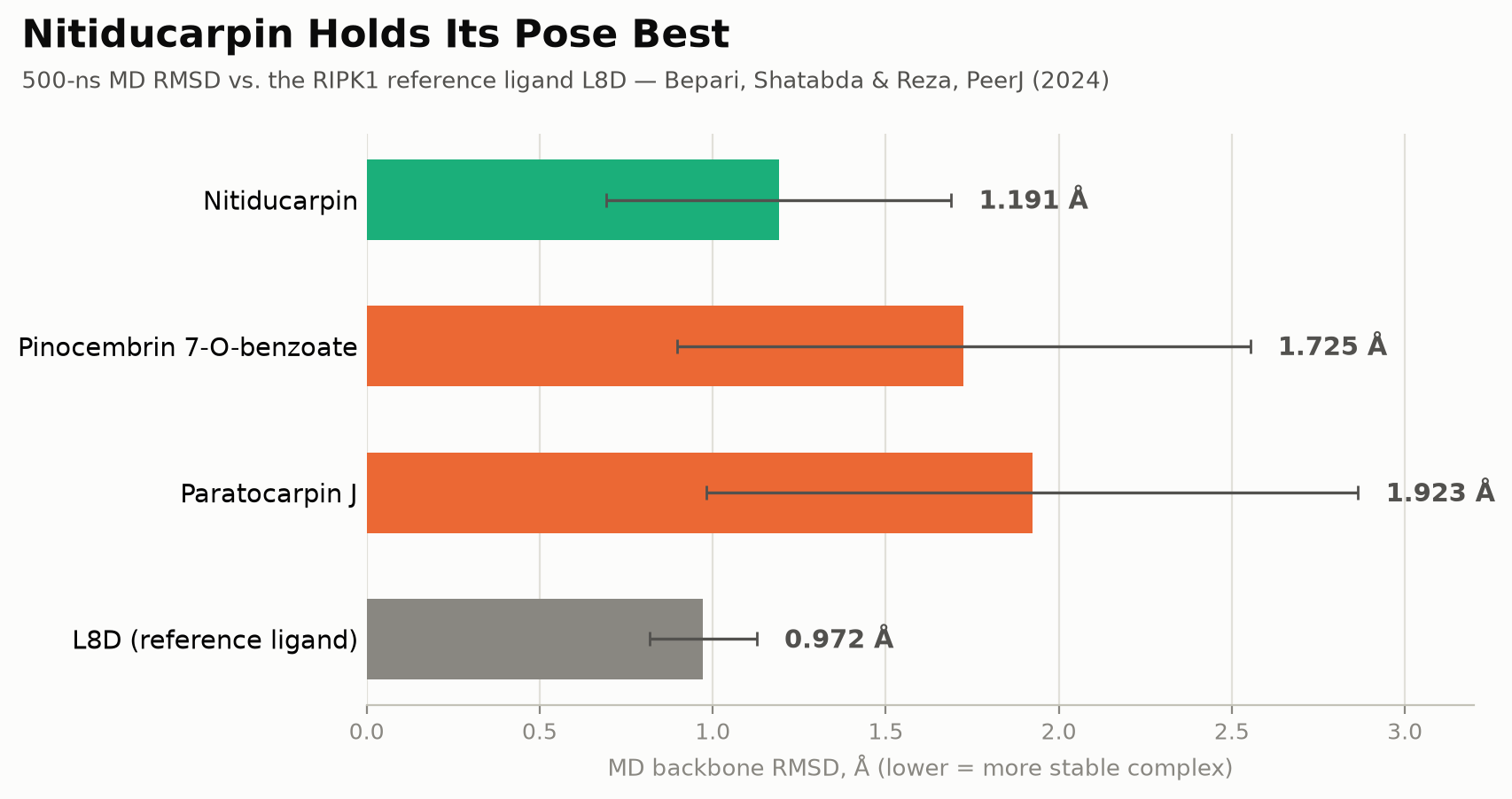
Each of the three finalists, plus RIPK1’s reference ligand L8D for comparison, went through replicated 500-nanosecond GROMACS molecular dynamics simulations with free energy calculations. The results separated the field clearly. Measured by root-mean-square deviation (RMSD) — how much the complex’s structure drifts from its starting pose over the simulation — Nitiducarpin came out on top at 1.191 Å (±0.498 Å), noticeably more stable than Paratocarpin J (1.923 Å) or Pinocembrin 7-O-benzoate (1.725 Å), and closer to the reference ligand’s 0.972 Å than either of its flavonoid competitors. Radius of gyration and solvent-accessible surface area measurements told the same story: lower, steadier values for Nitiducarpin across the board.
What’s actually happening at the binding site
Beyond the summary statistics, 2D protein-ligand interaction analysis showed Nitiducarpin forming persistent hydrophobic contacts with RIPK1’s catalytic triad and activation loop residues — the specific structural regions responsible for the kinase’s enzymatic activity and ligand binding. That’s a mechanistically meaningful detail, not just a good number: it suggests Nitiducarpin isn’t merely sitting somewhere in the pocket, but engaging the residues that actually matter for blocking RIPK1 function.
Where this leaves things
Nitiducarpin, Pinocembrin 7-O-benzoate, and Paratocarpin J are the three strongest computational candidates to come out of this screen, with Nitiducarpin showing the most convincing combination of binding affinity, blood-brain barrier potential, and simulated stability. None of that is a substitute for lab and animal testing — the paper is explicit that in vitro and in vivo follow-up is the necessary next step. But as a demonstration of how far structure-based virtual screening can narrow a search space before a single compound touches a lab bench, this is idgence’s computational drug discovery pipeline working exactly as designed.
This post summarizes original research authored by idgence’s Asim Kumar Bepari. Read the full open-access paper in PeerJ: doi.org/10.7717/peerj.16762