Meet Domeeko: The Free Toolkit That Turns Anyone Into a Virtual Chemist
A look at idgence’s open-source CLI for running a complete molecular docking pipeline — receptor prep through interaction analysis — in one command.
Running a molecular docking study for the first time usually means stitching together half a dozen separate tools by hand: one program to clean up the receptor structure, another to generate 3D ligand conformers, AutoDock Vina for the actual docking, and then a pile of ad-hoc scripts to rank results and check what’s actually touching what inside the binding pocket. Every step has its own file format, its own quirks, and its own way to quietly fail at 2 a.m.
Domeeko exists to collapse that into one command.
What it actually does
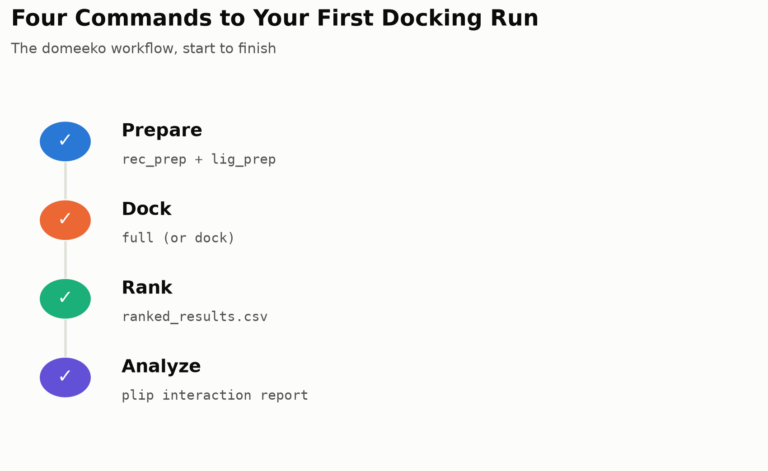
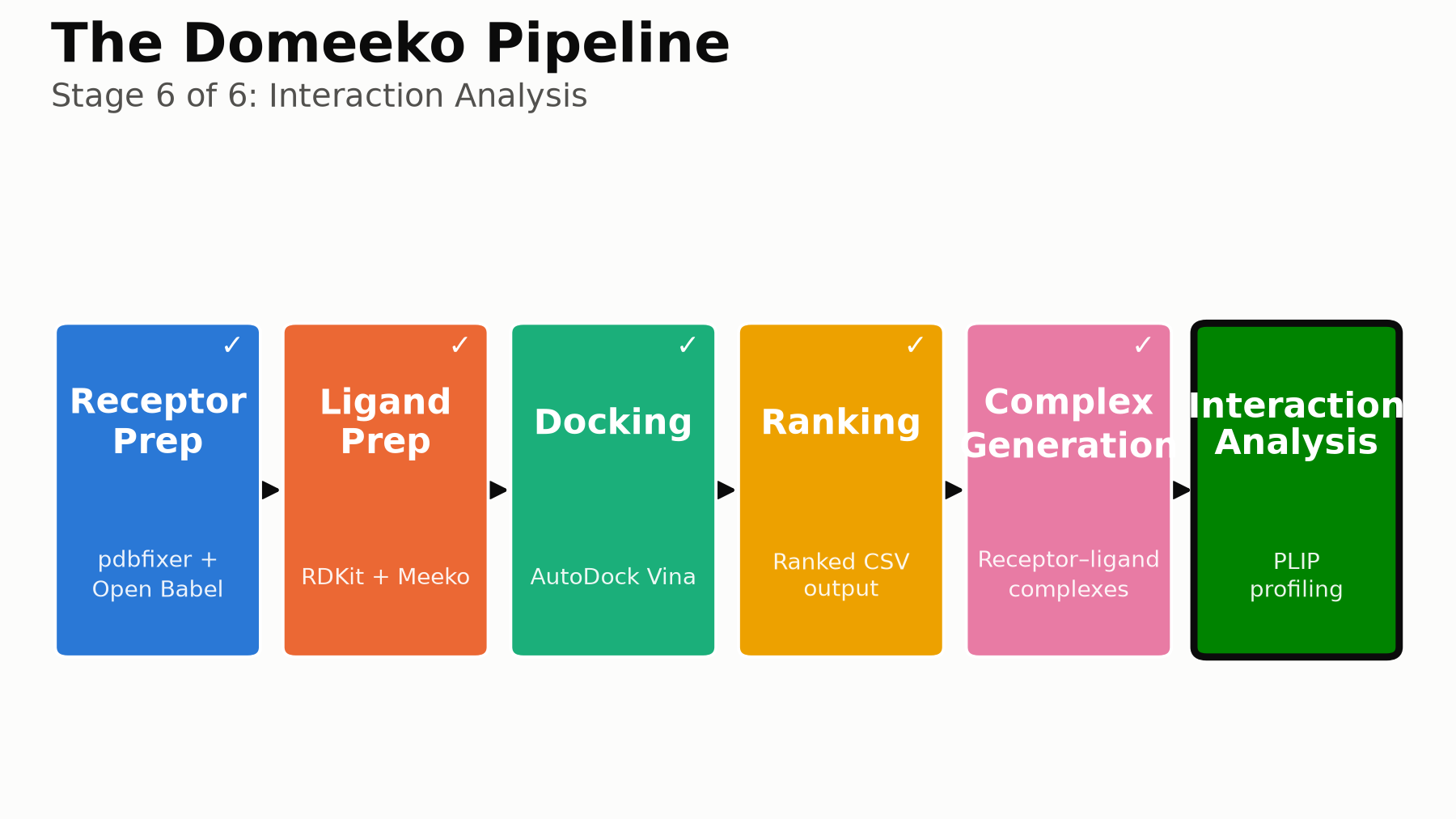
Domeeko is a modular, open-source command-line toolkit that automates the full docking pipeline end to end:
- Receptor preparation — cleans the protein structure, adds hydrogens, fixes residues, removes waters (via
pdbfixerand Open Babel) - Ligand preparation — generates 3D conformers and assigns charges (via RDKit and Meeko)
- Docking — runs AutoDock Vina with automated binding-box setup
- Ranking — sorts every ligand by predicted binding affinity into a structured CSV
- Complex generation — builds receptor–ligand complex structures for downstream MD or MM-PBSA work
- Interaction analysis — profiles each complex with PLIP, covering hydrogen bonds, hydrophobic contacts, π-stacking, π-cation interactions, salt bridges, water bridges, halogen bonds, and metal complexes
Run the whole thing with one line:
domeeko full --receptor protein.pdb --lig_dir ligands/Point it at a receptor PDB and a directory of ligands, and domeeko handles preparation, docking, ranking, complex building, and interaction profiling automatically — with CPU parallelization for high-throughput screening, automatic binding-box generation, and a summary at the end of the run showing exactly where every output file landed.
It doesn’t force an all-or-nothing workflow
Each stage is also available as its own command — lig_prep, rec_prep, dock, rank, make_complex, plip — so a project that already has prepared PDBQT files can skip straight to docking, or a study that only needs receptor cleanup can stop there. There’s also an interactive terminal menu (domeeko --menu) for anyone who’d rather navigate options than memorize flags.
Why idgence built it
Domeeko automates the same sequence of steps behind idgence’s own published computational drug discovery work — the kind of virtual screening and docking pipeline described in idgence’s Keap1 inhibitor study and RIPK1 inhibitor research. Manually re-running that sequence of tools for every new target and every new ligand library is exactly the kind of repetitive, error-prone work a CLI should eliminate. Domeeko packages it once, correctly, so the next screening project doesn’t start from zero.
What This Actually Looks Like
Boxes and arrows are a convenient shorthand, but docking happens in real 3D space, on a real protein. Below is the actual crystal structure idgence’s Keap1 study is built on — PDB 8A46, the Kelch domain, shown here with its co-crystallized ligand (L5F) animated into its bound pose.
This is the same structure described in idgence’s Keap1 inhibitor study — domeeko automates exactly the preparation and docking steps that produced this bound pose.
Getting started
Domeeko installs cleanly through conda or micromamba:
conda create -n docking-env -c conda-forge -c bioconda -c asimbepari domeeko
conda activate docking-env
It also runs directly from source for anyone who’d rather manage dependencies (RDKit, Open Babel, AutoDock Vina, Meeko, pdbfixer, and optionally PLIP) themselves. Full installation instructions, command reference, and examples are in the GitHub repository.
It’s free
Domeeko is released under the MIT License — free to use, modify, and build on, with no catch. If you’re running docking studies by hand right now, it’s worth five minutes to see whether domeeko already does what you’re scripting yourself.
Domeeko is developed and maintained by idgence’s Asim Kumar Bepari. Star or contribute at github.com/asimbepari/domeeko.